
1. Project Vision#
This is the first article in a series documenting, piece by piece, the implementation of my DevOps homelab. The project is an online Linux labs platform, called praxis-lab, designed to deliver Linux courses and give every student an isolated practice environment: a micro virtual machine accessible from the browser.
Choosing a homelab as the implementation environment is driven by three goals:
- Full control over the entire lifecycle, from virtual machine provisioning all the way to application deployment.
- Zero public-cloud cost, which allows iterating on complex architectures without budget constraints.
- Technical portfolio: every component is documented with the level of detail that would be expected in a production environment — a practice that transfers directly to SRE and DevOps roles.
The result is a fully automated end-to-end platform: a student opens a browser, selects a lab, and gets an interactive Linux terminal — with zero manual intervention by an administrator.
2. Overall System Architecture#
The system is divided into five clearly separated layers: virtualized hardware, Kubernetes platform, application, GitOps, and CI/CD. The high-level architecture diagram is shown below:
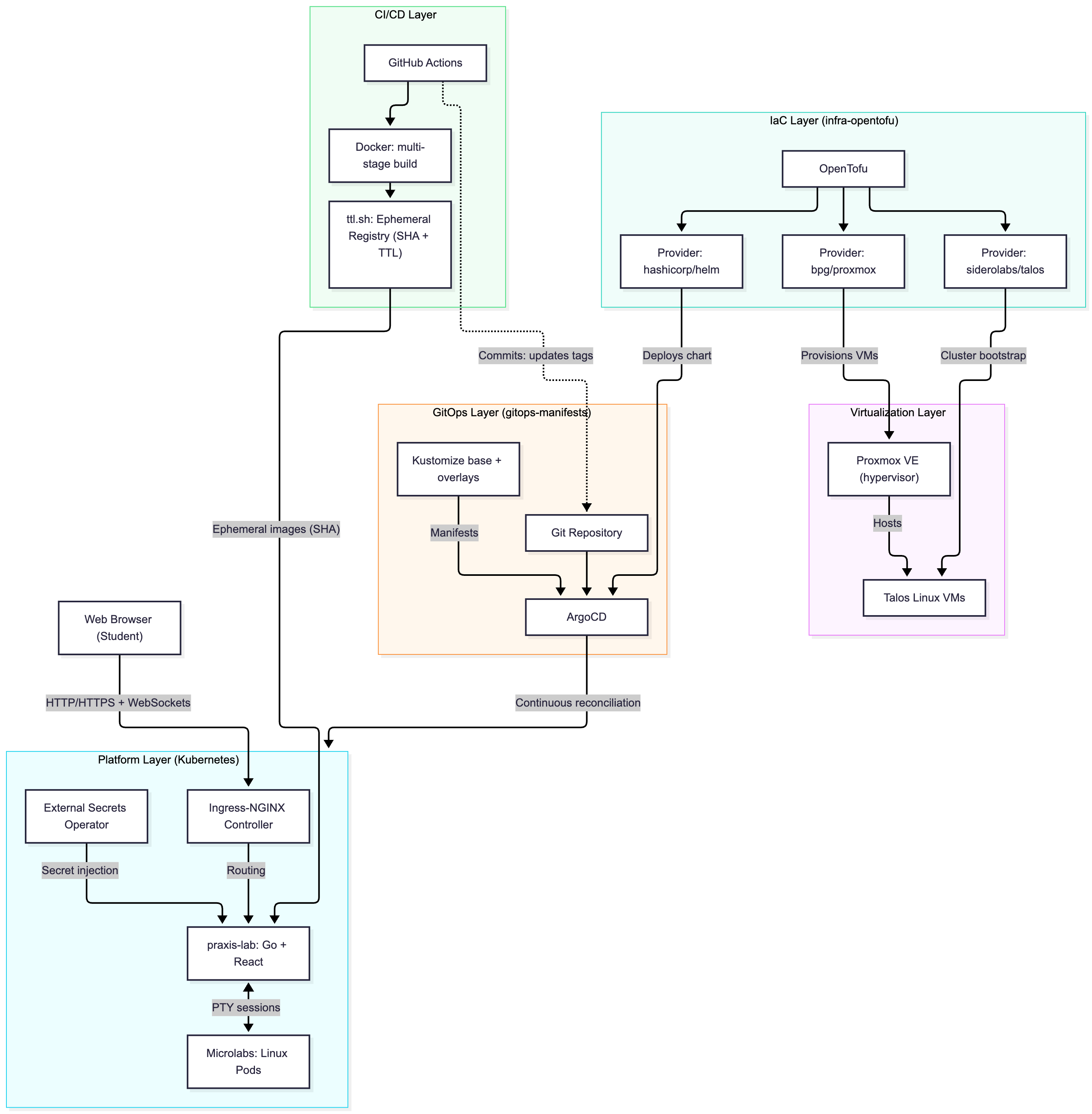
General Architecture from the DevOps Homelab
The organizing principle of the architecture is separation of responsibilities per repository:
| Repository | Responsibility | Technology |
|---|---|---|
infra-opentofu | Declarative VM provisioning, OS configuration, and GitOps bootstrap | OpenTofu, bpg/proxmox, siderolabs/talos, hashicorp/helm |
gitops-manifests | Single source of truth for the desired state of the platform in Kubernetes | ArgoCD, Kustomize, Ingress-NGINX, External Secrets Operator |
praxis-lab | Application source code for the labs platform | Go, SQLite, React, TypeScript, Vite, xterm.js |
The flow of control moves in a single direction: code → CI/CD → image registry → GitOps repository → ArgoCD → Kubernetes. No change is ever applied directly to the cluster; every state mutation goes through a commit, which guarantees full traceability and reversibility.
3. Technology Stack#
3.1. Infrastructure, Virtualization & Operating System (infra-opentofu)#
| Component | Role in the architecture |
|---|---|
| Proxmox VE | Type-1 bare-metal hypervisor hosting the Kubernetes virtual machines. |
| Talos Linux (Sidero Labs) | Immutable, minimal, security-hardened Linux distribution designed exclusively for Kubernetes. No SSH: fully managed through its API via talosctl. |
| OpenTofu (>= 1.6.0) | Infrastructure as Code engine. Declaratively defines compute, operating system configuration, and the GitOps pipeline bootstrap. |
bpg/proxmox provider | Declarative provisioning of virtual machines on Proxmox VE. |
siderolabs/talos provider | Talos machine configuration, cluster bootstrap, and kubeconfig generation. |
hashicorp/helm provider | Deploys the official ArgoCD chart directly into the Talos cluster: the entry point that “seeds” the GitOps engine. |
This chain is particularly interesting from an SRE perspective: the infrastructure is provisioned entirely from code (HCL for the VMs, declarative Talos configuration), and the resulting cluster is an immutable system — there is no mutable local state and no shell session on the nodes — a property that eliminates an entire class of configuration-drift problems.
3.2. GitOps & Kubernetes Platform (gitops-manifests)#
| Component | Role in the architecture |
|---|---|
| Kubernetes | Container orchestrator, bootstrapped and managed by Talos Linux. Runs the labs platform and its supporting services. |
| ArgoCD | GitOps controller: continuous pull-based reconciliation loop, ApplicationSets, and the App-of-Apps pattern. |
| Kustomize | Declarative templating engine: base/ manifests with dev and prod overlays to parameterize per environment without duplicating content. |
| Ingress-NGINX Controller | L7 reverse proxy at the cluster edge, configured to support WebSocket upgrades — a critical requirement for the interactive shells. |
| External Secrets Operator (ESO) | Declarative synchronization of secrets from an external secret manager into Kubernetes, keeping credentials out of the GitOps repository. |
3.3. Labs Application (praxis-lab)#
Backend (Go):
| Component | Role in the architecture |
|---|---|
| Go (>= 1.22) | Primary language. Implements the REST API and the WebSocket server. Static compilation produces small, efficient binaries, ideal for containers. |
| SQLite | Lightweight embedded persistence with no external service dependency. In Kubernetes it is configured with a PVC for persistence and WAL mode (Write-Ahead Logging) for reader/writer concurrency. |
Gorilla WebSocket / nhooyr.io/websocket | Real-time full-duplex communication between the student’s browser and the terminal processes. |
Linux PTY (creack/pty) | Pseudo-terminal allocation inside the container to run interactive command shells. |
Frontend (React):
| Component | Role in the architecture |
|---|---|
| React (>= 18) + TypeScript | Single Page Application user interface with static typing across components and services. |
| Vite | Fast bundling, development server with hot-reloading, and asset generation. |
xterm.js (+ fit and web-links addons) | Browser-based terminal emulator: consumes the WebSocket stream and renders it as a real shell session. |
| NGINX (Alpine) | Static web server inside the frontend container: serves the SPA and resolves client-side routing (fallback to index.html for deep links). |
3.4. CI/CD, Containers & Local Environment#
| Component | Role in the architecture |
|---|---|
| Docker | Multi-stage builds: the Go backend is compiled in one stage and copied onto a minimal base image; the frontend is built with Vite and served from NGINX Alpine. |
| ttl.sh (Ephemeral Registry) | Anonymous, ephemeral container registry with immutable tags via Git commit SHA and TTL (ttl.sh/<uuid>/praxis:sha-<commit>), eliminating credential management and token rotation in CI/CD. |
| GitHub Actions | CI pipelines: push triggers, linting and tests, image builds, publishing to ttl.sh, and an automatic commit of the new tags into gitops-manifests. |
| GNU Make | Task automation at both the repository root (homelab/Makefile) and the application (praxis-lab/Makefile). |
| Vim / Vi | Standard terminal editor for local configuration and script editing. |
4. End-to-End Flow: From Code to Lab#
The following sequence diagram describes the full cycle of a code change until a student uses it:
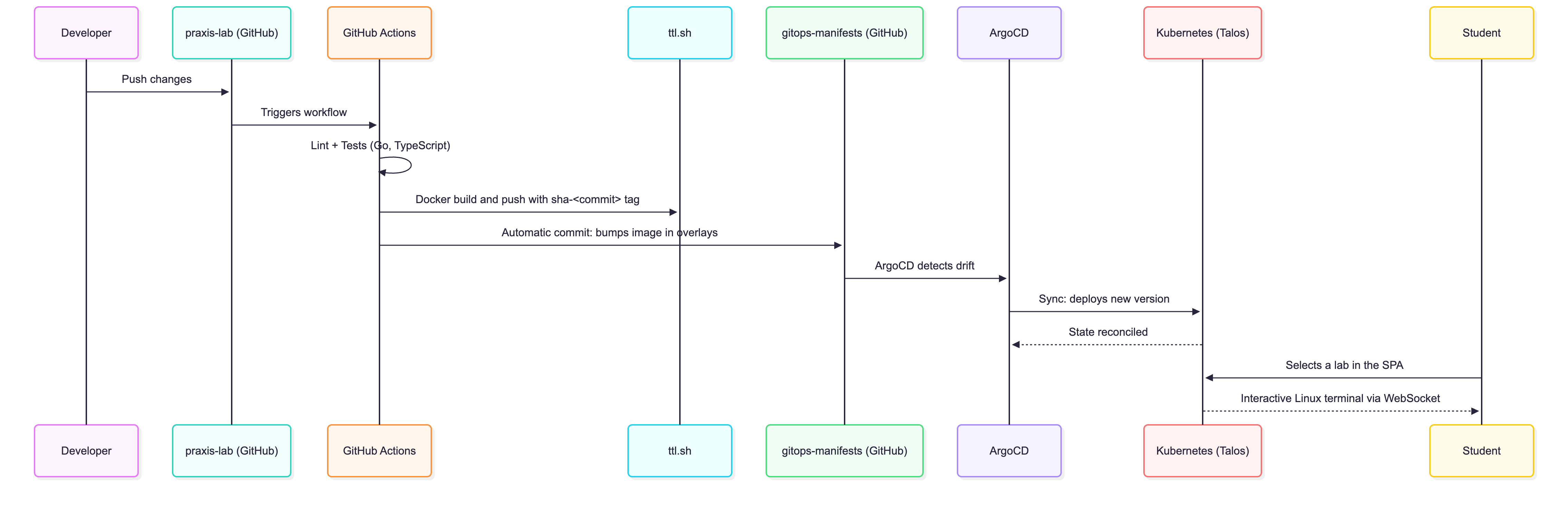
Sequence diagram
And the lab execution flow from the student’s perspective:

Execution flow
5. Design Principles#
The architecture is grounded in principles that apply directly to production SRE/DevOps operations:
- 100% declarative, reproducible infrastructure: from the VMs in Proxmox to the ArgoCD chart, all state is defined in versioned code. The entire environment can be rebuilt from the repositories alone.
- Immutable nodes: Talos Linux eliminates traditional server administration (no SSH, no mutable local state). The only management path is its API and its declarative configuration.
- GitOps: the
gitops-manifestsrepository is the single source of truth. ArgoCD continuously reconciles; any deviation of cluster state is either corrected or recorded as drift. - Immutable, traceable images: the SHA tag binds each deployed image to an exact commit. Rollback is a tag change, not a rebuild.
- Security by design: secrets never live in the repository (ESO injects them at runtime), traffic is segmented with NetworkPolicies, and access is controlled with RBAC.
- Low-friction local development: unified Makefiles at both levels let any pipeline task run locally with a single command.
6. Decision Records#
A few decisions deserve explicit mention:
| Decision | Alternative | Rationale |
|---|---|---|
| Proxmox VE + Talos Linux | Managed Kubernetes in the public cloud, or kubeadm on traditional distros | A type-1 homelab with immutable nodes eliminates the administration surface and configuration drift; Talos, being API-first, is fully manageable from OpenTofu. |
OpenTofu with bpg/proxmox + siderolabs/talos + hashicorp/helm providers | Manual steps with talosctl and helm install | The complete bootstrap (VMs → cluster → ArgoCD) must be idempotent, reproducible, and auditable from a single IaC layer. |
| SQLite + WAL + PVC instead of PostgreSQL | External database service | For a homelab, an embedded database removes an operational dependency. WAL allows concurrent writes alongside reads; the PVC guarantees volume persistence. |
| xterm.js + PTY over WebSocket | VNC, Serial Console, Jupyter | A real POSIX terminal with a minimal surface: no graphical protocol, no notebook server — just a full-duplex byte stream. |
| ArgoCD App-of-Apps + ApplicationSets | Manual list of Applications | Manages n applications (currently praxis-lab; soon the labs themselves) from a single controlling Application, scaling without duplication. |
| Ephemeral registry ttl.sh with SHA tags | Traditional private registries with credentials / latest tags | Removes token and secret management from CI/CD; TTL handles automatic cleanup while SHA guarantees exact traceability. |
7. Series Structure#
Each article in the series dives deep into one layer of the architecture described in section 2:
| # | Article | Layer |
|---|---|---|
| 1 | Introduction and Overall Architecture (this article) | Big picture |
| 2 | Infrastructure as Code: Proxmox, Talos Linux, and OpenTofu (bpg/proxmox, siderolabs/talos, hashicorp/helm) | infra-opentofu |
| 3 | GitOps with ArgoCD, Kustomize, and secret management with ESO | gitops-manifests |
| 4 | CI/CD with GitHub Actions, Docker multi-stage, and ephemeral publishing on ttl.sh | CI/CD |
| 5 | The praxis-lab application: Go backend (REST, WebSockets, PTY, SQLite) and React frontend (xterm.js) | praxis-lab |
| 6 | Observability and resilience: metrics, logs, alerting, and recovery strategy | Operations |
8. Conclusions#
This project demonstrates a complete DevOps pipeline implemented on self-owned hardware: IaC (OpenTofu provisioning Proxmox and Talos), GitOps (ArgoCD + Kustomize), CI/CD (GitHub Actions + Docker + ttl.sh), and a business application with non-trivial real-time requirements (interactive terminals over WebSocket) and persistence (SQLite on Kubernetes).
The homelab serves as a proving ground: the patterns documented are identical to those that would be applied on a managed public-cloud cluster, with the difference that every decision — and every failure — is fully inspectable and reproducible.
The next article dives deep into the infrastructure layer: the complete provisioning chain — VMs on Proxmox with bpg/proxmox, immutable cluster bootstrap with siderolabs/talos, and ArgoCD seeding with hashicorp/helm.